Permit for Home Addition in Shasta County
Do I Need a Permit for Home Addition in Shasta County? 2026 Homeowner Guide
Yes, you usually need a permit for home addition in Shasta County if the project adds square footage, changes the structure, creates habitable space, moves walls, adds a room, expands a garage, changes electrical, plumbing, gas, mechanical, foundation, framing, or roof systems. Shasta County says most residential improvements, including new structures, additions, remodels, and major appliance installations, require an approved building permit and inspection.
In 2026, Shasta County permit applications must also follow the 2025 California Building Standards Code for applications submitted on or after January 1, 2026. (Shasta County CA) That means homeowners should plan early for energy code, wildfire, climate zone, structural, and site-specific reviews before starting construction.
Who Is This Shasta County Permit Guide For?
This guide is useful if you are:
- Planning a room addition in Redding, Anderson, Shasta Lake, Palo Cedro, Cottonwood, or unincorporated Shasta County
- Expanding a kitchen, bedroom, garage, laundry room, or living room
- Converting a garage, attic, porch, or enclosed patio into living space
- Building in a wildfire-prone or rural area
- Unsure whether you need Building, Planning, Environmental Health, Fire, or Public Works review
- Buying or selling a home with old unpermitted work
- Acting as an owner-builder
- Hiring a general contractor and want to avoid permit mistakes
Table of Contents
Here’s the thing most homeowners miss: the permit is not just paperwork. It is the county’s way of checking whether your addition is safe, legal, insurable, and sellable.
Why Does Shasta County Require a Permit for Home Additions?
Shasta County requires permits for most home additions because additions affect life safety, structural loads, fire protection, energy use, property value, and long-term code compliance. A home addition is not the same as replacing flooring or painting a room.
A real addition changes the building. It may add load to the foundation, alter roof framing, extend electrical circuits, modify HVAC sizing, affect septic capacity, or change fire exposure. That is why the county wants plans before work begins.
Shasta County’s permit process page tells homeowners to contact the Building Division for new construction, remodeling, similar work to existing buildings, and project issues involving electrical, plumbing, foundations, framing, utilities, and grading.
That single sentence matters. It means a simple “we’re just adding a room” project can touch several review areas.
A contractor-style way to think about it is this:
| Work Type | Permit Likely Needed? | Why |
| Bedroom addition | Yes | Habitable space, framing, electrical, energy |
| Kitchen expansion | Yes | Structure, plumbing, electrical, mechanical |
| Garage expansion | Yes | Foundation, framing, fire separation |
| Porch enclosure | Usually yes | New conditioned or enclosed space |
| Second-story addition | Yes | Structural engineering, stairs, seismic loads |
| Small detached shed under 120 sq ft | Maybe not building permit, but zoning still matters | Shasta Lake guidance shows 120 sq ft exemption for certain detached accessory buildings, with limits |
| Cosmetic flooring or paint | Usually no building permit | No structural or system changes |
My strong opinion: never let a contractor say, “Nobody checks this out here.” That is not a permit strategy. That is a resale problem waiting to happen.
What Counts as a Home Addition in Shasta County?
A home addition is any project that increases the floor area, height, usable living space, or physical footprint of an existing home. It can be attached, interior, vertical, or a conversion of existing space.
Common Shasta County home addition examples include:
- New bedroom
- Larger kitchen
- Primary suite
- Family room
- Attached garage expansion
- Enclosed porch
- Sunroom
- Second story
- Garage conversion
- Laundry room expansion
- Mudroom
- Bathroom addition
- ADU or junior ADU, when applicable
Solano County’s room addition guidance gives a useful California-style definition: a room addition is an extension or increase in floor area or height, and the California Energy Commission treats residential room additions as an increase of conditioned space to an existing conditioned building.
That “conditioned space” phrase is important. If you heat or cool the new area, the energy code comes into play. In 2026, California’s 2025 Energy Code applies to buildings with permit applications submitted on or after January 1, 2026.
When Do You Need a Permit for Home Addition in Shasta County?
You need a permit for home addition in Shasta County when the project enlarges, alters, repairs, moves, changes occupancy, or modifies regulated electrical, gas, mechanical, or plumbing systems. That is the safe answer.
Shasta County’s own compliance document says owners or authorized agents must apply to the building official before constructing, enlarging, altering, repairing, moving, demolishing, changing occupancy, or replacing regulated electrical, gas, mechanical, or plumbing systems.
That covers nearly every real addition.
You almost certainly need a permit if your project includes:
- New foundation or slab
- New exterior wall
- New roof tie-in
- New window or egress opening
- Added electrical circuits
- Added bathroom or laundry plumbing
- HVAC extension or replacement
- Gas line work
- Structural beam removal
- Load-bearing wall changes
- New bedroom or sleeping area
- Garage-to-living-space conversion
- Septic system impact
- Flood zone work
- WUI wildfire construction requirements
What if the addition is small?
Small does not automatically mean permit-free. A 90 sq ft bathroom addition can still need structural, plumbing, electrical, mechanical, and energy review. A 600 sq ft detached accessory building may have different rules than a 120 sq ft tool shed.
In City of Shasta Lake guidance, one-story detached accessory structures used as sheds or playhouses may be exempt from a building permit if they do not exceed 120 sq ft and meet location rules. But detached buildings over 120 sq ft require plans and a permit.
That exemption does not mean an attached bedroom addition is exempt.
What Permits Might Be Needed Besides the Building Permit?
A building permit may not be the only approval needed for a home addition in Shasta County. Planning, Environmental Health, Fire, Public Works, Air Quality, school fee clearance, grading, septic, well, encroachment, and WUI reviews may also apply.
Shasta County tells applicants to contact Planning for zoning, General Plan designation, new uses, and parcel splits. It also points homeowners to Environmental Health for wells, septic tanks, drainfields, septic testing, and private or public water systems.
That is where rural Shasta County projects get complicated.
| Review Area | When It May Apply | Homeowner Pain Point |
| Building Division | Structural work, additions, remodels | Plan check and inspections |
| Planning Division | Setbacks, zoning, lot coverage | Addition may be too close to property line |
| Environmental Health | Septic, well, drainfield | Extra bedroom may affect septic capacity |
| Public Works | Driveway, encroachment, drainage | Rural access or right-of-way work |
| Fire or WUI review | Wildfire areas | Materials and defensible construction |
| School impact fees | Added square footage | Extra cost before permit issuance |
| Flood review | FEMA flood hazard areas | Elevation certificate may be needed |
Shasta County’s 2026 design criteria document says a flood Elevation Certificate is required for new construction or substantial improvements in a flood hazard zone. It also states that special inspections may be required under the 2025 CRC and CBC.
This is why a permit for home addition in Shasta County should start with a parcel check, not with a hammer.
What Changed in 2026 for Shasta County Home Addition Permits?
The biggest 2026 change is that Shasta County permit applications submitted on or after January 1, 2026, follow the 2025 California Building Standards Code. Shasta County directly states that the new code affects all new building permit applications submitted on or after that date.
This matters for homeowners because a design that worked under the 2022 code may need updates under the 2025 code cycle.
California’s 2025 Energy Code also became active for permits submitted on or after January 1, 2026. The California Energy Commission says the 2025 Energy Code expands heat pump use in new residential buildings, encourages electric-readiness, strengthens ventilation standards, and applies to buildings with permit applications submitted on or after January 1, 2026.
The state also says the 2025 Energy Code applies to new buildings and major renovations and is expected to save Californians nearly $4.8 billion in energy costs over 30 years.
What this means
Your 2026 addition may need closer attention to:
- Insulation
- Windows
- HVAC sizing
- Duct sealing
- Ventilation
- Heat pump readiness
- Energy compliance forms
- CALGreen details
- WUI fire-resistant materials
- Climate zone selection
- Special inspection triggers
Shasta County also notes that it contains Climate Zone 11 and Climate Zone 16. Zone 11 generally covers the hotter, drier valley floor, while Zone 16 covers colder higher-elevation mountain areas. Applicants should identify the correct climate zone early because it affects design.
That is a major content gap competitors miss.
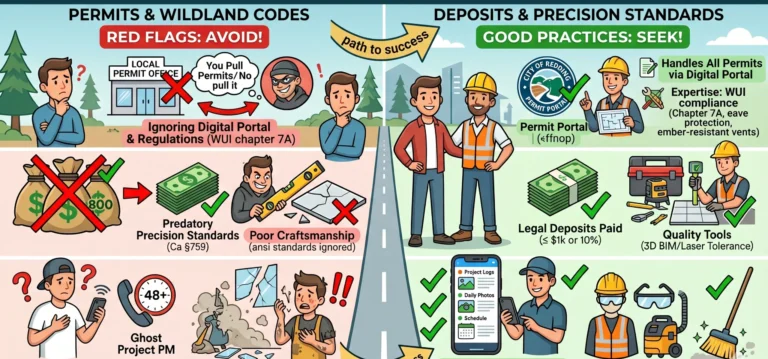
How Do WUI Wildfire Rules Affect a Permit for Home Addition in Shasta County?
If your Shasta County property is in a Wildland Urban Interface area, your addition may need wildfire-resistant construction materials and detailing. This can affect roofing, vents, siding, eaves, decks, windows, and exterior assemblies.
Shasta County’s design criteria document says building construction in the WUI area must comply with the 2025 Wildland Urban Interface Code, and approved building materials can be found through CAL FIRE.
For homeowners, WUI is not a small footnote. It can change the project budget.
Common WUI-sensitive items include:
- Class A roof assemblies
- Ember-resistant vents
- Ignition-resistant siding
- Enclosed eaves
- Fire-rated exterior walls near property lines
- Tempered glazing in some conditions
- Deck material restrictions
- Defensible space considerations
Here’s what nobody tells you early enough: wildfire details are cheaper on paper than in the field. If your framer already built open eaves and the inspector wants a different assembly, the correction costs more than a better plan set would have.
A good Shasta County contractor should ask one early question:
“Is the parcel in WUI?”
If they do not ask, you should.
How Much Does a Permit for Home Addition in Shasta County Cost?
The cost of a permit for home addition in Shasta County depends on project valuation, plan review, inspections, school impact fees, septic or well review, fire review, and site-specific conditions. There is no single flat price for every addition.
Shasta County publishes monthly building permit statistics with fees and values, including January and February 2026 permit reports. (Shasta County CA) That shows the county tracks real permit costs by project type and valuation.
School impact fees are another often-missed cost. The Shasta County Office of Education lists the 2025 to 2026 residential developer fee at $5.17 per square foot for the July 1, 2025 to June 30, 2026 fee schedule. It explains that fees are typically paid as a condition of obtaining a building permit or certificate of occupancy.
Example school fee math
| Addition Size | Residential School Fee at $5.17 per sq ft | Estimated School Fee |
| 200 sq ft | $5.17 | $1,034 |
| 400 sq ft | $5.17 | $2,068 |
| 600 sq ft | $5.17 | $3,102 |
| 800 sq ft | $5.17 | $4,136 |
This is not the full permit cost. It is one possible fee category.
City of Redding uses its own Master Fee Schedule. Its 2025 to 2026 schedule took effect July 1, 2025. That matters because a project inside Redding may follow city permit fees, while a project in unincorporated Shasta County goes through the county.
Contractor-style budget note: I would not plan a Shasta County addition without a permit and fee contingency. Keep a separate permit, plan check, engineering, school fee, and correction allowance. Even a clean project can get one extra round of comments.
How Long Does Shasta County Permit Approval Take?
A simple Shasta County permit can take several days, while more complex additions can take several weeks or longer. Planning hearings, environmental review, incomplete plans, septic questions, fire review, or engineering corrections can stretch the timeline.
Shasta County says routine development applications that do not need public hearing or environmental review can range from several days to several weeks. It also says routine electrical permits may take only several days, while large or complex projects can take several weeks. Planning items needing hearings may take six to ten weeks or longer.
For a home addition, the timeline depends on:
- Quality of drawings
- Structural complexity
- WUI location
- Flood zone status
- Septic or well issues
- Zoning setbacks
- Fire access
- Whether plans are complete
- How fast your contractor answers comments
Realistic 2026 planning timeline
| Stage | Typical Planning Window |
| Concept and site check | 1 to 2 weeks |
| Design and measurements | 2 to 6 weeks |
| Engineering, if needed | 1 to 4 weeks |
| Permit submittal | 1 day |
| Completeness check | Several days |
| Plan review | Several weeks, varies |
| Corrections and resubmittal | 1 to 3 weeks |
| Permit issuance and fees | Several days |
| Construction inspections | Throughout project |
| Final approval | After all corrections pass |
My practical advice: do not schedule the crew as if permit approval is automatic. That is how homeowners end up paying standby costs while the permit sits in review.
How Do You Apply for a Permit for Home Addition in Shasta County?
To apply for a permit for home addition in Shasta County, start with parcel research, confirm zoning and site constraints, prepare plans, use the correct county forms, submit through Build Shasta or the Permit Counter, respond to plan check comments, pay fees, and schedule inspections.
Shasta County provides a Building Permit Application dated March 2026, a Plot Plan Example, Owner Builder Forms, a Residential Plan Submittal Checklist, and a Building Design Criteria Request for the 2025 CBC and CRC.
The county also accepts building permit applications through the Build Shasta web portal. Applications are processed after completeness is verified and in the order received. The county says applicants are notified by email when more information is needed or when the permit is ready for issuance.
Step-by-step Shasta County process
- Confirm whether the property is in unincorporated Shasta County or a city jurisdiction.
- Check zoning, setbacks, easements, parcel size, and flood status.
- Confirm septic, well, and utility constraints.
- Confirm WUI and climate zone.
- Prepare a plot plan.
- Prepare architectural plans.
- Add structural engineering when needed.
- Prepare energy compliance documents.
- Complete the Building Permit Application.
- Submit through Build Shasta or in person.
- Respond to plan check comments.
- Pay permit and required related fees.
- Keep approved plans on site.
- Schedule required inspections.
- Pass final inspection before using the addition.
This is where many homeowners fail. They submit a sketch, not a permit-ready plan set. A sketch shows an idea. A plan set proves code compliance.
What Drawings and Documents Do You Usually Need?
Most Shasta County home additions need a permit application, plot plan, construction drawings, structural details, energy documents, owner-builder or contractor information, and sometimes septic, well, WUI, flood, or special inspection documents.
Expect some version of this package:
| Document | Why It Matters |
| Building Permit Application | Opens the official permit record |
| Plot plan | Shows property lines, setbacks, easements, structures |
| Floor plan | Shows existing and proposed layout |
| Foundation plan | Shows footing, slab, crawlspace, piers |
| Framing plan | Shows beams, rafters, joists, shear walls |
| Roof plan | Shows drainage, tie-ins, roof covering |
| Elevations | Shows exterior height, windows, materials |
| Energy forms | Required for conditioned additions |
| Structural calculations | Needed for complex framing or engineering |
| WUI material notes | Needed in wildfire areas |
| Septic clearance | Needed when bedroom count or wastewater load changes |
| School fee clearance | Often needed before permit issuance |
| Owner-builder form | Needed if homeowner pulls permit as owner-builder |
City of Redding’s FAQ gives a useful warning: permits and plan reviews vary by size, complexity, and completeness of submitted plans.
Translation: incomplete plans cost time.
Can a Homeowner Pull an Owner-Builder Permit in Shasta County?
Yes, a homeowner may be able to pull an owner-builder permit, but that makes the homeowner responsible for permits, inspections, code compliance, subcontractor coordination, safety, and project integrity. This is not a casual signature.
The California Contractors State License Board says that when you sign a permit application as an owner-builder, you assume full responsibility for all phases of the project and its integrity. You must pull permits, pass codes and inspections, order materials, pay suppliers, supervise subcontractors, and may be considered an employer if you use anyone other than a licensed subcontractor.
CSLB also provides a license lookup tool and recommends checking a contractor license before hiring.
California also requires written home improvement contracts for projects over $500. CSLB says a written contract is required for all home improvement projects over $500, and changes must be in writing.
My blunt contractor-style opinion
Owner-builder is fine if you truly know construction, scheduling, inspections, lien releases, workers’ comp exposure, and trade sequencing.
Owner-builder is dangerous if someone says, “Pull the permit yourself so I can save you money.”
That line should make your stomach tighten.
What Happens If You Build Without a Permit in Shasta County?
Building without a permit can lead to correction costs, stop-work issues, fines, insurance problems, loan problems, resale delays, title concerns, and even removal of unpermitted work. The risk does not disappear with time.
Shasta County says a complete permit record helps protect home value, provides peace of mind that work was inspected, and may matter because some insurance carriers may not cover unpermitted work while some lenders may require permit compliance before approving a loan.
City of Redding’s unpermitted construction handout is even more direct. It says additions, modifications, alterations, demolition, or change of occupancy require valid permits, inspections, and final approval. It also says unpermitted construction is a code violation and may lead to administrative fines, criminal prosecution, civil abatement, clouded title, liens, special assessments, receivership, or other legal action.
The part most people hate hearing is this:
Time passing does not fix unpermitted construction.
City of Redding states that who performed the unpermitted work and when it happened does not matter. The property owner and city building records are the deciding factors.
That is why buyers on Reddit worry so much about unpermitted additions. The fear is not theoretical. It affects loans, insurance, appraisal, square footage, and resale confidence. (Reddit)
Can You Legalize an Old Unpermitted Addition in Shasta County?
Possibly, but legalizing an old unpermitted addition depends on the structure, safety, available records, inspection access, code path, and whether Shasta County accepts the project into its compliance process.
Shasta County has a Residential Building Permit Compliance Program for existing unpermitted residential structures, accessory structures, room additions, remodels, pools, grading, and other site improvements. The program can also help complete records for construction that received permits but never passed final inspection.
The county says the goal is to identify a reasonable and affordable pathway to compliance, but participation does not guarantee compliance can be achieved.
That last sentence is the hard truth.
A legalizing process may require:
- As-built plans
- Engineer report
- Open wall inspection
- Foundation verification
- Electrical corrections
- Plumbing corrections
- Smoke and CO alarms
- Energy or safety upgrades
- Septic review
- WUI material review
- Final inspection
If the inspector cannot see framing, wiring, or foundation details, some areas may need to be opened. That is where “it was built well” becomes hard to prove.
What Are the Most Common Permit Mistakes in Shasta County Home Additions?
The most common mistakes are starting work too early, ignoring Planning review, forgetting septic limits, missing WUI requirements, submitting weak plans, assuming a shed exemption applies to attached additions, and not closing the permit with a final inspection.
Here is the contractor-style checklist I would use before submittal:
| Mistake | Why It Hurts | Better Move |
| Starting before permit issuance | May trigger stop-work or corrections | Wait for permit approval |
| Ignoring setbacks | Addition may violate zoning | Check Planning early |
| Forgetting septic | Bedroom count can affect system capacity | Contact Environmental Health early |
| Missing WUI | Materials may need redesign | Verify WUI status before plans |
| Weak plot plan | Review delays | Use county plot plan example |
| No energy documents | 2026 code requires compliance | Include Title 24 forms |
| Owner-builder without knowledge | Liability risk | Use licensed trades or a GC |
| No final inspection | Permit record stays incomplete | Schedule and pass final |
| Wrong jurisdiction | Lost time | Confirm city vs county first |
| No school fee budget | Surprise cost | Calculate added sq ft fee |
Here’s what most people do: they design the room first and ask permit questions later.
Better order:
Parcel first. Code second. Design third. Budget fourth. Build last.
That sequence saves money.
Does a Permit for Home Addition in Shasta County Affect Property Taxes?
A home addition may affect assessed value because it adds new construction or square footage. The permit itself is not the tax. The improvement is what may change the assessed value.
California counties often reassess new construction separately from the existing home. Reddit homeowners frequently discuss this because unpermitted additions may still create assessment issues if discovered.
For Shasta County homeowners, the safer approach is to plan for three separate money buckets:
- Construction cost
- Permit, plan, impact, and professional fees
- Long-term property tax and insurance changes
This is not meant to scare you. It is meant to stop surprise math.
Before you build, ask your contractor or designer to separate the estimate into:
- Labor
- Materials
- Engineering
- Title 24 energy documents
- Permit fees
- School impact fees
- Septic or utility work
- WUI material upgrades
- Contingency
A clean estimate is not always the lowest estimate. It is the estimate that does not hide the real work.
What Should You Ask a Contractor Before a Shasta County Home Addition?
Ask who pulls the permit, who prepares plans, who handles corrections, who schedules inspections, who pays reinspection fees, and whether WUI, septic, energy code, and school fees are included. These questions expose weak contractors fast.
Use these questions before signing:
- Have you permitted additions in Shasta County before?
- Will the permit be in your name or mine?
- Who prepares the plan set?
- Is engineering included?
- Are Title 24 energy documents included?
- Did you check WUI status?
- Did you check septic or well issues?
- Are school impact fees included?
- Who answers plan check comments?
- Who schedules inspections?
- What happens if the inspector requires corrections?
- Is final inspection included before final payment?
- Is your CSLB license active?
- Do you carry workers’ compensation and liability insurance?
- Will all change orders be in writing?
CSLB recommends using its license check tool before hiring a contractor.
My favorite red flag question is simple:
“What permit issues do you expect on my parcel?”
A good contractor will answer with specifics. A weak one will say, “Should be easy.”
FAQs About Permit for Home Addition in Shasta County
Do I need a permit for home addition in Shasta County if I do the work myself?
Yes, in most cases. Owner-builder status does not remove permit requirements. It only changes who is responsible. CSLB says owner-builders must pull permits and pass inspections.
Do I need a permit to convert my garage into living space?
Usually yes. A garage conversion changes occupancy and often adds insulation, electrical, HVAC, fire separation, windows, and energy code requirements.
Does a small bedroom addition need a permit?
Yes. A bedroom addition creates habitable space and usually affects framing, electrical, egress, smoke alarms, energy code, and possibly septic capacity.
Can I start work while waiting for permit approval?
Do not start structural or regulated work before approval. City of Redding says additions and alterations require a valid permit, inspections, and final approval.
How do I know if my property is in unincorporated Shasta County?
Check your jurisdiction before applying. Redding, Shasta Lake, Anderson, and other cities may have separate permit offices and fee schedules.
Will Shasta County inspect my home addition?
Yes. Permitted additions require inspections at required stages. Redding notes that permit cards list required inspections and scheduling instructions.
What if my contractor says permits are optional?
That is a red flag. Shasta County’s own compliance guidance says most residential additions and remodels require approved permits and inspections.
Do I need a permit for a detached shed?
Maybe. In Shasta Lake guidance, certain detached one-story accessory buildings under 120 sq ft may be building-permit exempt, but zoning and placement rules still apply.
Does WUI apply to additions or only new homes?
It can apply to construction in WUI areas. Shasta County says building construction in WUI areas must comply with the 2025 Wildland Urban Interface Code.
Will school fees apply to my addition?
Possibly. Shasta County Office of Education lists a 2025 to 2026 residential developer fee of $5.17 per square foot and says these fees are typically paid as a condition of obtaining a building permit or certificate of occupancy.
Can old unpermitted work be legalized?
Possibly. Shasta County has a Residential Building Permit Compliance Program, but the county states that participation does not guarantee compliance can be achieved.
What is the safest first step?
Call or contact the correct permit office before design is finalized. For unincorporated areas, Shasta County lists the Building Division at 1855 Placer Street, Suite 102, Redding, CA, with office hours Monday to Friday.
Final Takeaway
If you are asking, “Do I need a permit for home addition in Shasta County?”, the practical answer is yes for nearly every real addition. The smarter question is, “Which approvals do I need before I spend money on drawings, materials, or labor?”
In 2026, the best Shasta County home addition plan starts with parcel research, zoning, WUI status, septic capacity, energy code, climate zone, school fees, and a clean permit-ready plan set.
Permits can feel slow. I get it. But unpermitted work is slower when you sell, refinance, insure, or try to fix it later.
Build it once. Permit it correctly. Close the final inspection.
2026 Material Watch
For Shasta County additions in 2026 and beyond, watch these materials and systems:
- Smart Glass: Better solar control for hot valley areas, especially Climate Zone 11.
- Heat Pump Integration: California’s 2025 Energy Code encourages heat pump adoption and electric-readiness.
- Recycled Steel Framing: Useful where fire resistance, dimensional stability, and sustainability matter.
- Ember-Resistant Vent Systems: Important for WUI areas.
- Low-GWP Insulation: A growing choice for energy compliance and sustainability.
- High-Performance Windows: Helpful for Title 24 energy compliance and comfort.
- Fire-Resistant Siding: Worth considering for rural and wildfire-prone parcels.
- Panelized Wall Systems: May reduce site time if local plan review and engineering are handled correctly.
.