
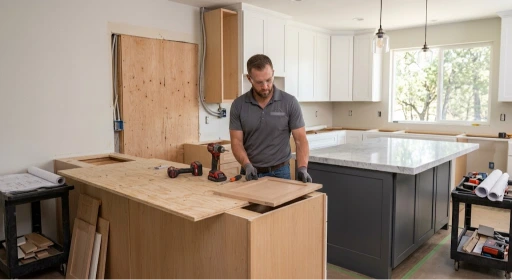
Kitchen Remodel vs. Kitchen Renovation
Key Takeaways
A kitchen renovation usually updates an existing kitchen, while a kitchen remodel can change its layout, systems, or structure. However, homeowners and contractors often use the two terms interchangeably. In Redding, the scope of work matters more than the label. Replacing cabinets and countertops may be a smaller project. Moving walls, plumbing, gas lines, or electrical circuits creates a more complex remodel. That difference can affect permits, cost, scheduling, and disruption. Before getting quotes, define exactly what you want changed so contractors can price the same scope.
Kitchen Remodel vs. Kitchen Renovation: What’s the Real Difference?
If you search for kitchen remodel vs kitchen renovation, you will find slightly different definitions.
The simplest distinction is this:
A renovation generally refreshes or improves the existing kitchen. A remodel can change how the kitchen is laid out, built, or used.
But there is an important catch.
The words are not used consistently across the remodeling industry. A contractor may call a large project a renovation. Another may call the same project a remodel.
So don’t choose a contractor based on the word they use.
Instead, look at the scope of work.
For example, replacing cabinets, countertops, lighting, and flooring while keeping the existing layout is usually a lighter renovation or remodel.
Moving the sink, removing a wall, relocating appliances, or changing electrical and plumbing systems is a deeper remodel.
That distinction matters much more than the name on the proposal.
Kitchen Renovation vs. Kitchen Remodel at a Glance
| Factor | Kitchen Renovation | Kitchen Remodel |
| Main goal | Refresh or improve the existing kitchen | Change or substantially improve the kitchen |
| Layout | Usually stays similar | May change significantly |
| Cabinets | Refinish, reface, or replace | Replace or redesign |
| Countertops | Often replaced | Often replaced |
| Appliances | Usually stay in existing locations | May be relocated |
| Plumbing | Usually limited | May be relocated |
| Electrical | Usually limited | May require new circuits |
| Walls | Usually unchanged | May be removed or modified |
| Permits | Depends on the work | More likely when systems or structure change |
| Disruption | Usually lower | Usually higher |
| Best for | A kitchen that works but looks dated | A kitchen that no longer works for your needs |
The table is a planning guide, not a legal definition. Your actual permit requirements depend on the work being performed and the applicable building requirements.
What Is a Kitchen Renovation?
A kitchen renovation generally improves an existing kitchen without substantially changing its basic layout.
For example, you might keep the sink, range, refrigerator, cabinets’ general footprint, and walls in their current locations.
You could then update:
- Cabinet doors or cabinet finishes
- Countertops
- Backsplash
- Flooring
- Paint
- Hardware
- Lighting fixtures
- Appliances
- Faucets
- Decorative finishes
This approach can make a dated kitchen feel completely different.
It may also make sense when the existing layout already works well.
When does a kitchen renovation make sense?
A renovation may be appropriate if:
- You like the current kitchen layout.
- The room has enough storage.
- Appliances are in convenient locations.
- You do not need to remove walls.
- The electrical and plumbing systems are suitable for the planned work.
- You mainly want a visual update.
In this situation, changing the entire layout may add cost without solving a real problem.
What Is a Kitchen Remodel?
A kitchen remodel generally goes beyond surface improvements.
It can change the way the kitchen functions or how its space is organized.
A remodel might include:
- Changing the kitchen layout
- Moving an island
- Relocating appliances
- Moving a sink
- Changing plumbing locations
- Adding or changing electrical circuits
- Removing or modifying a wall
- Adding storage
- Creating a more open connection to another room
- Replacing cabinets
- Installing new countertops
- Improving lighting
- Reworking flooring
- Rebuilding much of the kitchen
GCR’s Redding kitchen remodeling service includes layout planning, custom cabinetry, countertops, islands, lighting and electrical work, plumbing, and appliance integration. The more systems you change, the more important proper planning becomes.
Which Is More Expensive: A Kitchen Remodel or Renovation?
A larger remodel will usually cost more than a limited renovation because it can involve more labor, materials, design work, demolition, inspections, and trade coordination.
But there is no reliable single price difference between the two.
Two kitchens with the same square footage can have very different project costs.
The biggest cost drivers can include:
- Cabinet quality
- Countertop material
- Appliance choices
- Plumbing relocation
- Electrical work
- Wall removal
- Structural changes
- Flooring
- Lighting
- Custom millwork
- Permitting
- Design work
- Labor
- Hidden conditions discovered after demolition
Current national data shows how wide the range can be. The 2026 U.S. Houzz Kitchen Trends Study reported median spending of $20,000 for minor kitchen remodels and $55,000 for major remodels among its surveyed homeowners.
Those are national survey figures, not Redding price quotes.
For a Redding project, the better approach is to price the actual scope instead of applying a national average.
Does a Kitchen Remodel Increase Home Value?
It can improve a home’s appeal and functionality, but you should not assume that every remodeling dollar will be recovered at resale.
The 2025 Cost vs. Value report found that its national midrange minor kitchen remodel example had a job cost of $28,458, a reported resale value of $32,141, and a calculated cost recouped of 112.9%.
That figure should not be treated as a guaranteed return for a Redding homeowner.
Market conditions, neighborhood, project quality, home value, materials, and buyer preferences all matter.
A better reason to remodel is often a combination of:
- Better daily functionality.
- Improved storage.
- Updated finishes.
- Better use of available space.
- Improved condition.
- Potential resale appeal.
What About Kitchen Remodeling Permits in Redding?
Permit requirements depend on the specific work.
Do not assume that calling a project a “renovation” means it does not need a permit.
The City of Redding’s building application specifically includes residential Remodel/Repair and Remodel/Repair (Express) work classifications.
The city’s permit records also show kitchen-related residential work being processed under remodel and repair classifications. For example, a 2022 Redding permit record included a general kitchen remodel involving cabinets and countertops.
Work involving structural changes, electrical systems, plumbing, gas, or other regulated construction may require permits and inspections.
The safest approach is to confirm requirements with the applicable building department before construction begins.
GCR’s kitchen remodeling process states that its team handles permitting and inspection scheduling with the City of Redding or Shasta County as applicable.
Why Redding Homeowners Should Think About Scope First
Redding homes can vary widely in age, layout, construction, and existing conditions.
That means a kitchen that looks like a simple cosmetic project may reveal additional work once cabinets, flooring, or walls are opened.
For example, you may plan to replace cabinets.
Then you discover that the electrical layout does not support the appliances you want.
Or you want a kitchen island.
The island may require electrical work.
Or you want to move the sink.
That can change the plumbing scope.
This is why a good kitchen remodeling estimate should describe what is actually changing, rather than simply saying “kitchen renovation.”
When Should You Remodel Instead of Renovate?
A deeper remodel may make more sense when the existing kitchen has functional problems.
Consider remodeling if:
- The kitchen feels cramped.
- The workflow is awkward.
- You lack adequate storage.
- Appliances are poorly positioned.
- You want an island.
- You need additional electrical capacity.
- You want to relocate plumbing.
- You want to remove a wall.
- The kitchen does not suit how your family cooks.
- The existing layout prevents you from getting the improvements you want.
Function is often a better reason to remodel than appearance alone.
The 2026 Houzz Kitchen Trends Study found that 38% of renovating homeowners cited kitchen deterioration or dysfunction as a reason to renovate, while 41% cited dissatisfaction with the old kitchen’s style.
That is a useful reminder: homeowners are not only remodeling for looks.
They are also trying to make kitchens work better.
When Is a Renovation the Better Choice?
A lighter renovation may be the better option when the room already functions well.
For example:
Your kitchen works well, but the cabinets look dated.
You may not need to change the floor plan.
Your countertops are worn, but appliance locations are fine.
Replacing the countertops may solve the problem.
Your kitchen lacks visual appeal but has adequate storage.
New finishes, lighting, hardware, and backsplash may be enough.
The goal should be to spend money on the problems that actually bother you.
Can You Combine a Renovation and Remodel?
Yes.
Real kitchen projects do not always fit into one category.
You could keep your kitchen’s overall footprint while replacing cabinets and countertops, then make one layout change.
For example:
Keep the existing walls, replace the cabinets, install new countertops, add an island, and relocate one electrical outlet.
That project contains both renovation-style updates and remodeling work.
This is another reason why rigid definitions can be misleading.
The scope of work is what your contractor needs to understand.
What Should You Ask a Redding Kitchen Contractor?
Before comparing quotes, ask each contractor to explain the same basic scope.
Ask these questions:
- What work is included?
- Are demolition and disposal included?
- Are cabinets included?
- Are countertops included?
- Are appliances supplied or installed?
- Will plumbing move?
- Will electrical circuits change?
- Will walls be removed or modified?
- Who handles permits?
- Who schedules inspections?
- What is excluded?
- How are unexpected conditions handled?
- What is the estimated project timeline?
- What payment schedule applies?
- Is the contract detailed and in writing?
California’s Contractors State License Board says a written contract is required for home improvement projects over $500, and the contract should clearly describe the work, materials, cost, and other agreed terms.
You can also use the CSLB’s official contractor search to verify licensing information before signing a contract.
What Are Homeowners Spending on Kitchen Features in 2026?
Current kitchen research also shows that homeowners are focusing heavily on functionality.
The 2026 Houzz study found that 84% of renovating homeowners upgraded cabinets. It also reported that 76% incorporated built-in features, with pantry cabinets appearing in 47% of projects.
That does not mean you need to copy national trends.
Instead, consider which features solve a real problem in your kitchen.
For example:
- More pantry storage
- Better drawer organization
- A larger work surface
- Improved task lighting
- Appliance storage
- A practical island
- Better traffic flow
A trendy feature that makes your kitchen harder to use is not necessarily an improvement.
A Simple Decision Test for Redding Homeowners
Ask yourself three questions.
1. Do I like my current layout?
Yes: A renovation or limited remodel may be enough.
No: Consider a larger remodel.
2. Do I need to move plumbing, electrical, appliances, or walls?
No: Your project may be relatively straightforward.
Yes: Expect more planning and potentially more permitting and trade coordination.
3. Is the problem mostly appearance or functionality?
Appearance: Start by exploring renovation-style updates.
Functionality: A remodel may provide a better long-term solution.
This three-question test can help you avoid paying for construction you do not need.
How Long Does a Kitchen Remodel Take?
There is no reliable universal timeline.
A cabinet and countertop update can be much simpler than a project involving demolition, structural changes, plumbing relocation, electrical work, custom cabinets, and inspections.
The project schedule can also depend on:
- Design decisions
- Material availability
- Cabinet lead times
- Permit processing
- Inspection scheduling
- Trade coordination
- Unforeseen site conditions
- Changes made during construction
GCR similarly states that its kitchen timelines depend on project scope, permitting, and whether structural, plumbing, or electrical changes are involved.
Before signing, ask for a project-specific timeline rather than relying on a generic “six-week remodel” estimate.
How to Compare Kitchen Remodeling Quotes
Do not automatically choose the lowest number.
Instead, compare what each contractor is actually offering.
A useful comparison includes:
| Item | Quote A | Quote B |
| Demolition | Included? | Included? |
| Cabinets | Brand/specification | Brand/specification |
| Countertops | Material | Material |
| Plumbing | Scope | Scope |
| Electrical | Scope | Scope |
| Flooring | Included? | Included? |
| Permits | Included? | Included? |
| Cleanup | Included? | Included? |
| Project management | Included? | Included? |
| Exclusions | Listed? | Listed? |
| Payment schedule | Defined? | Defined? |
A low quote can become expensive if important work is excluded.
A detailed quote makes the comparison much easier.
Final Answer: Remodel or Renovation?
If your kitchen already has a functional layout and you mainly want new finishes, cabinets, countertops, lighting, or appliances, a renovation-style project may be enough.
If your kitchen has poor flow, inadequate storage, outdated electrical or plumbing arrangements, or a layout that does not fit your lifestyle, a larger remodel may be the better choice.
But don’t get stuck on the terminology.
When comparing kitchen remodel vs kitchen renovation, focus on what will actually change.
That is what determines the project’s complexity, budget, timeline, and potential permit requirements.
If you are planning a project in Redding, you can explore GCR’s Redding kitchen remodeling services to see the types of layout, cabinetry, countertop, electrical, plumbing, and finish work that can be included in a project.
Have a question about your kitchen project? Call GCR at (530) 999-5991 to discuss your goals and determine what type of project may fit your home.
Frequently Asked Questions
1. Is a kitchen remodel the same as a kitchen renovation?
Not always. The terms are often used interchangeably. Generally, renovation refers to updating an existing space, while remodeling can involve changing the layout, structure, or function. The actual scope matters more than the label.
2. Is a kitchen renovation cheaper than a remodel?
It can be, especially when the renovation keeps the existing layout and avoids major plumbing, electrical, or structural changes. However, material choices and project scope can make either project expensive.
3. Do I need a permit for a kitchen remodel in Redding?
It depends on the work. Structural changes and certain electrical, plumbing, mechanical, or other construction work may require permits. Confirm requirements with the applicable Redding or Shasta County building authority before starting work.
4. Can I remodel my kitchen without changing the layout?
Yes. You can replace cabinets, countertops, flooring, lighting, appliances, and finishes while keeping the basic layout. This can be a practical option when the existing kitchen functions well.
5. Does moving a kitchen sink make the project a remodel?
It can increase the project’s complexity because relocating a sink may require changes to plumbing. The terminology is less important than accurately identifying the work involved.
6. How much does a kitchen remodel cost in Redding, CA?
There is no reliable single price for every Redding kitchen. Cost depends on the kitchen’s size, materials, cabinets, labor, plumbing, electrical work, structural changes, permitting, and other project-specific factors.
7. How long does a kitchen remodel take?
The timeline depends on the scope. A simple update can take less time than a full remodel involving demolition, layout changes, custom cabinetry, plumbing, electrical work, and inspections.
8. Should I remodel my kitchen before selling my house?
Not necessarily. A remodel may improve functionality and buyer appeal, but you should consider your home’s market, neighborhood, expected selling timeline, and project cost before making a large investment.
9. What should I include in a kitchen remodeling contract?
The contract should clearly identify the work, materials, costs, payment terms, and other important project conditions. California CSLB guidance recommends a detailed written home improvement contract for applicable projects.
10. How do I choose a kitchen remodeling contractor in Redding?
Compare licensing, insurance, experience, project scope, written estimates, contract terms, communication, and references where available. California homeowners can also use the official CSLB contractor search to verify licensing information.